Physical Address
304 North Cardinal St.
Dorchester Center, MA 02124
Physical Address
304 North Cardinal St.
Dorchester Center, MA 02124

Beyond the Final Whistle
Beyond the Final Whistle
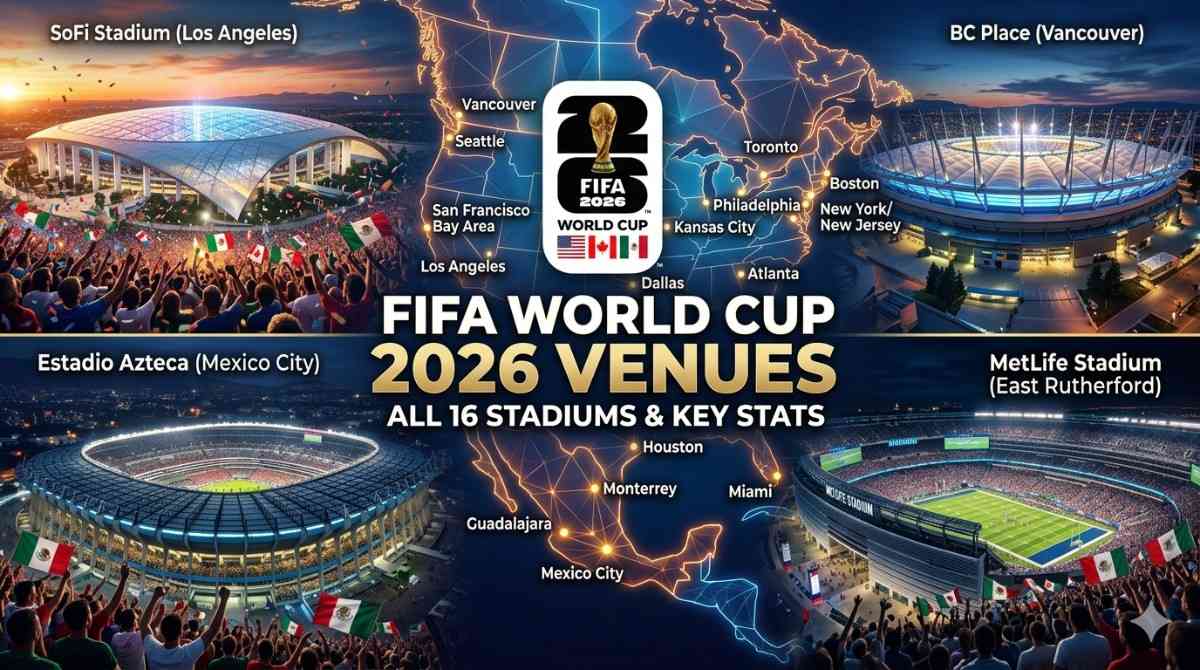
The FIFA World Cup 2026 spans three countries for the first time in tournament history. The United States, Mexico, and Canada share hosting duties across 16 stadiums and 16 host cities.
The tournament also marks the first 48-team World Cup, with 104 matches in total. Here is a full breakdown of every venue, ranked by capacity, along with the stats that matter most.
| Rank | Stadium | City | Country | Capacity |
|---|---|---|---|---|
| 1 | Estadio Azteca | Mexico City | Mexico | 80,824 |
| 2 | MetLife Stadium | East Rutherford, New Jersey | USA | 80,663 |
| 3 | AT&T Stadium | Arlington, Texas | USA | 70,649 |
| 4 | SoFi Stadium | Inglewood, California | USA | 70,492 |
| 5 | Arrowhead Stadium | Kansas City, Missouri | USA | 69,045 |
| 6 | Levi’s Stadium | Santa Clara, California | USA | 68,827 |
| 7 | NRG Stadium | Houston, Texas | USA | 68,777 |
| 8 | Lincoln Financial Field | Philadelphia, Pennsylvania | USA | 68,324 |
| 9 | Mercedes-Benz Stadium | Atlanta, Georgia | USA | 68,239 |
| 10 | Lumen Field | Seattle, Washington | USA | 66,925 |
| 11 | Hard Rock Stadium | Miami Gardens, Florida | USA | 64,478 |
| 12 | Gillette Stadium | Foxborough, Massachusetts | USA | 64,146 |
| 13 | BC Place | Vancouver, British Columbia | Canada | 52,497 |
| 14 | Estadio BBVA | Monterrey, Nuevo León | Mexico | 51,243 |
| 15 | Estadio Akron | Zapopan, Jalisco | Mexico | 45,664 |
| 16 | BMO Field | Toronto, Ontario | Canada | 43,036 |
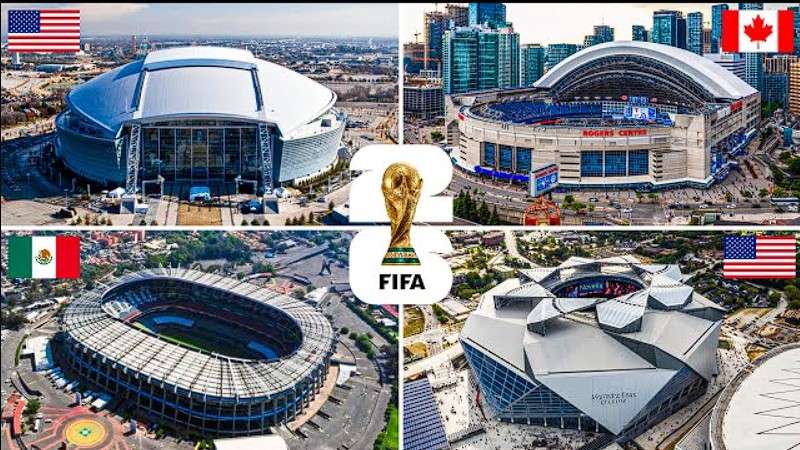
Capacity: 80,824
Estadio Azteca opened in 1966 and sits more than 7,200 feet above sea level. It hosted World Cup finals in 1970 and 1986, making it the only stadium to stage two finals. For 2026, it hosts the tournament opener between Mexico and South Africa, plus several more group and knockout matches. FIFA refers to it as Mexico City Stadium for the duration of the event.
Capacity: 80,663
MetLife Stadium opened in 2010 and serves as the home of the NFL’s Giants and Jets. FIFA calls it New York New York-New Jersey Stadium for the tournament. It hosts eight matches in total, including the World Cup final on July 19. The final will also feature the first halftime show in World Cup history.
Capacity: 70,649
Known to football fans as “Jerry World,” AT&T Stadium opened in 2009 with a retractable roof and climate control. It hosts more matches than any other venue, nine in total, including a semifinal on July 14. The stadium is also home to the Dallas Cowboys.
Capacity: 70,492
SoFi Stadium opened in 2020 and features a translucent roof without climate control. It hosted the United States’ opening match on June 12 and staged a quarterfinal on July 10. The venue sits inside a larger entertainment complex near Los Angeles.
Capacity: 69,045
Arrowhead Stadium, officially GEHA Field at Arrowhead for the NFL, once held the Guinness World Record for loudest crowd roar at a sports stadium. It stages group matches plus a quarterfinal on July 11. The venue keeps its open-air bowl design for the tournament.
Capacity: 68,827
Levi’s Stadium opened in 2014 and has hosted two Super Bowls, in 2016 and 2026. It stages group stage matches through the tournament. The stadium sits in the Bay Area, home to the San Francisco 49ers.
Capacity: 68,777
NRG Stadium opened in 2002 with a retractable roof. It hosts several group stage matches and also stages a special ceremony on July 4 to mark the United States Semiquincentennial. The venue sits within the larger NRG Park complex.
Capacity: 68,324
Lincoln Financial Field opened in 2003 and is home to the NFL’s Philadelphia Eagles. Like NRG Stadium, it hosts a Semiquincentennial ceremony on July 4. The venue has previously staged the Women’s World Cup and the Copa America Centenario.
Capacity: 68,239
Mercedes-Benz Stadium opened in 2017 with an octagonal design inspired by the Pantheon in Rome. Its retractable roof uses an eight-panel pinwheel system. The venue hosts eight matches, including a semifinal on July 15.
Capacity: 66,925
Lumen Field is an open-air stadium that opened in 2002. It hosts group stage and knockout matches throughout the tournament. The venue sits close to downtown Seattle with views of the city skyline.
Capacity: 64,478
Hard Rock Stadium has hosted six Super Bowls and the 2024 Copa America final. A 2016 renovation added a protective roof over the seating areas. For 2026, it hosts a quarterfinal on July 11 and the third-place match.
Capacity: 64,146
Gillette Stadium is home to the New England Patriots and features a 218-foot lighthouse landmark with a 360-degree observation deck. It hosts a quarterfinal on July 9, along with several group stage matches.
Capacity: 52,497
BC Place opened in 1983 and later added a retractable roof. It hosted the opening and closing ceremonies of the 2010 Winter Olympics. The venue stages group stage matches for the 2026 tournament.
Capacity: 51,243
Estadio BBVA opened in 2015 and carries the nickname “The Steel Giant.” Fans in parts of the stadium get a view of the nearby Cerro de la Silla mountain. The venue hosts group stage matches during the tournament.
Capacity: 45,664
Estadio Akron opened in 2010 and serves as the home ground of Liga MX club Chivas. It previously hosted the opening and closing ceremonies of the 2011 Pan American Games. It is the only venue at the 2026 tournament that hosts group stage matches only, with no knockout fixtures.
Capacity: 43,036
BMO Field is the smallest venue at the tournament. It underwent a major expansion ahead of 2026 to meet FIFA’s minimum capacity requirements. The stadium hosts Canada’s opening match on June 12 and a Round of 32 fixture later in the tournament.
Sixteen stadiums, three countries, and one shared goal: a World Cup unlike any before it. From the high altitude of Estadio Azteca to the lighthouse at Gillette Stadium, each venue brings its own identity to the 2026 tournament. Together, they form the stage for the biggest FIFA World Cup in history.